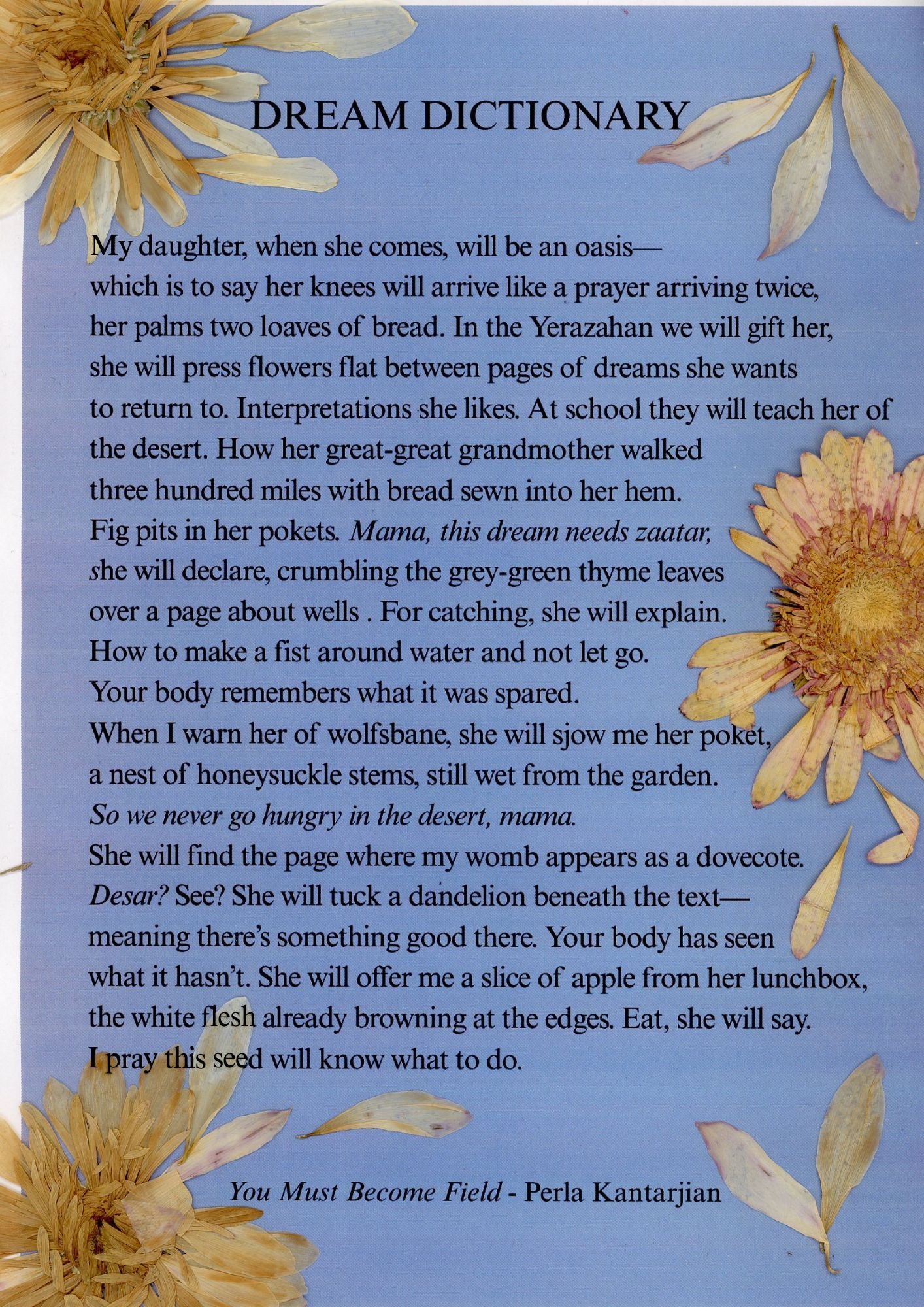
Recently the heart of the Armenian Institute (our cozy London office) filled with visitors buzzing over the phenomenal work authored by Perla Kantarjian. In conversation with Sarah Mnatzaganian; an award winning poet and writer herself, Perla took the room on a journey through her debut poetry collection You Must Become Field.
The collection is written as poetry of witness–a mode of writing used by poets who have personally endured or observed historical and social injustice and adversity. Reading the book, you travel through ‘Acts,’ rather than chapters, of personal history–a choice that defines these poems as collected corporeal experiences.
Prior to the event, I had a chance to speak to both Perla and Sarah about the book as well as their overall practices. Our conversation flowed between cultural identity shaping stylistic choices, to the representation of womanhood in narratives of erasure and displacement, to creative writing as a form of documentation for social change. It was exciting to speak to two talented writers, whose backgrounds inform their writing in critical and compelling ways.
Poetry As a Form of Journalism
Upon first reading of You Must Become Field, I was impressed by Perla’s ability to narrate through centuries of histories in a way that felt informative but did not take away, in the slightest, from a world that borders on magic. Reading each story about a character, a place, or the poet herself felt like an embodied experience that moved you across time, languages, and borders. Later, I discovered that earlier in her writing career, Perla was a journalist and Executive Editor at Annahar newspaper in Lebanon. I was immediately intrigued to find out if her journalistic experience was behind why her imagery in poetry felt as vivid as a photograph.
Sarah Mnatzaganian shares a similar background in journalism. To her, using writing to the best of her ability has always been a primary goal which in practice looks like fluidity between writing forms. In comparison of the two, journalism and poetry, Perla shared an observation that:
“Journalism is for fast emotional expression, aimed towards short attention spans. It plays its part. I use poems now to talk about real events because it is a strong tool for social conversation…I think of poetry as a new form of journalism”
In the age of social media, fake news, and news outlet monopolies, reliable reports of events have become more difficult to discern. While creative writing forms are frequently generalised as fiction, poetry of witness, and the poetry genre as a whole, often defies those boundaries. It is an approach of fluidity, that Sarah speaks of, that allows many writers to mould their lived experience into creative writing that not only guides the reader through a story, but accounts for lived and historical events. As Perla herself says, growing up switching between Armenian, Arabic and English, and constantly reading the news of another explosion, she wrote a book that only she could have written.
A poem that stands out as an example of poetry as an impactful form of documentation is ‘Beirutshima, August 4,’ which appears nearing the end of Act 2. When reading it for the audience at AI, Perla brought tears to our eyes. To protect your experience of this poem, I will not go into much detail on its contents. This poem, along with many others in the collection, is truly something that should be experienced by both those who are grieving and those who question why we want to talk so badly about tragedies that remain invisible to the geopolitically privileged world. ‘Beirutshima, August 4’ left sorrow in all of our hearts, but as Sarah thoughtfully said, ‘now we remember.’ This may not mean much out of context, but Sarah’s comment underscored the value of poetry as a form of journalism. Perla began writing poems on social media to raise awareness on the atrocities of war in Lebanon and Artsakh. They helped directly to raise funds for a cause. However, an even more longlasting effect that translating memory into poetry has, is documenting the losses that are missed or are immeasurable. It is turning numbers, records and lists into something or someone that ‘now we remember.’
You Must Become Field
We are often told not to judge a book by its cover, but in my humble opinion, you should absolutely judge this book by its cover, which is beautifully designed. During the Q&A, Perla expanded on her inspirations behind the illustration: a table with a selection of items deeply associated with Armenian and Lebanese culture. Captivated by an art exhibit that focused on familial settings in Lebanese homes, the table immediately reminded Perla of her own family’s gatherings, and how central this space was to her upbringing in a Lebanese-Armenian family. With an addition of a couple of things to reflect her Armenian home, the cover was born. Some of these items along with the vivid pink colour of the book capture the elements of girlhood that lace together this collection. From contemplating women’s experience during the Armenian Genocide, to retteling personal stories of girlhood, this book recognises the distinct role of femininity within settings of war and heritage of displacement.
Feeling responsible to restore is something that is felt by many Armenians towards our heritage. It often shows up in our homes and upbringing through small acts of nationalism that appear anecdotally amongst poems. For Armenian women this feeling of responsibility comes with the added weight of procreation. Policies on population control are often constructed with a disregard for the people responsible for the labor, literal in both ways, of this process. Outside of policy-making, the national and familial pressures of repopulation post-erasure is doubly felt.
My interpretation of the title poem suggested that the creation of this collection protests a more conventional approach to restoring a population. While procreation in all its forms is intended by the book, Perla responded that she was more fascinated by the possibility of the word Field. A living plane that provides sustenance, a place of burial and warfare, a woman’s body and womb.
““The poem centers the Armenian woman’s experience.””
The book calls the Armenian people to become field, to grieve our past and bring to life our future, whatever shape it may take.
What Gets Translated?
In the first couple of pages you will find an inscription:
“This book moves between English, Armenian and Arabic with borders porous.”
This statement sets us off on a journey through a mind unique to a multicultural upbringing familiar to many of the Armenian diaspora. As an artist who herself works with multi-lingual text and performance, and as someone who grew up speaking multiple languages, I was excited to see this assertion. This natural state of thinking, dreaming, speaking in multiple languages, which are used relatively equally, is often overlooked. As a multilingual person you are often considered to be fluent in languages you use but you are never considered to be a user of a new unique language with its own syntax and grammar. That evening, hearing the way people’s languages slid over one another, words and phrases patched together by thought and mutual understanding, brought a smile to my face.
When I asked Perla how she curated which language is used when, she responded that the way the book is written is simply the way her mind operates. Regarding translation, Perla, Sarah and I all agreed that the English language does not do justice to some sentiments, particularly those charged with emotion. These words Perla intentionally prefers to keep for the Armenian and Lebanese community, however her detailed footnotes ensure that the book remains accessible without making itself digestible. Balancing how your writing is perceived by a range of people who all have different levels of access to what is written, is hard. Often, artists and writers who connect with their cultural identity through their work are asked to alter its appearance to resemble their culture more evocatively, or instead less explicitly. Many of us find ourselves managing these expectations but we produce our best work with honesty. Sarah does a beautiful job at portraying her Anglo-Armenian upbringing in her debut poetry collection, Lemonade in the Armenian Quarter, which interweaves poems that speak with care to different parts of her identity.
Bring It To Your Table
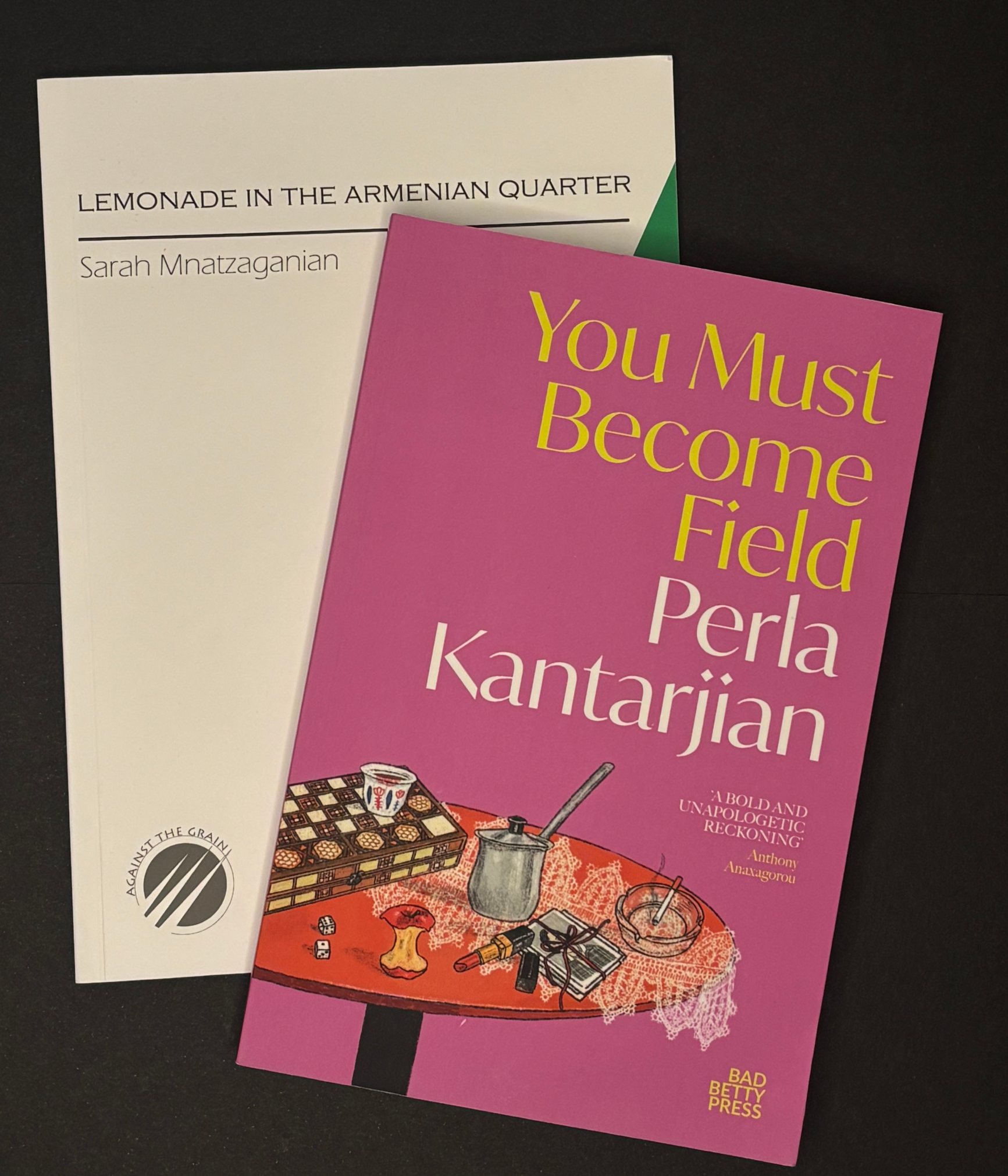
It is fair to say that the room was completely captivated during the readings that Perla kindly shared with us that night. Conversations ran long into the evening, until we sadly had to close our doors. I am sure these talks carried themselves around to tables at home, much like the one depicted on the cover of You Must Become Field, to bring reminiscence, grieving, healing, and hope to each family. The book can be ordered directly from Bad Betty Press or found at mainstream retailers like Waterstones and Amazon UK. Buy it, read it, and bring it to your table.