
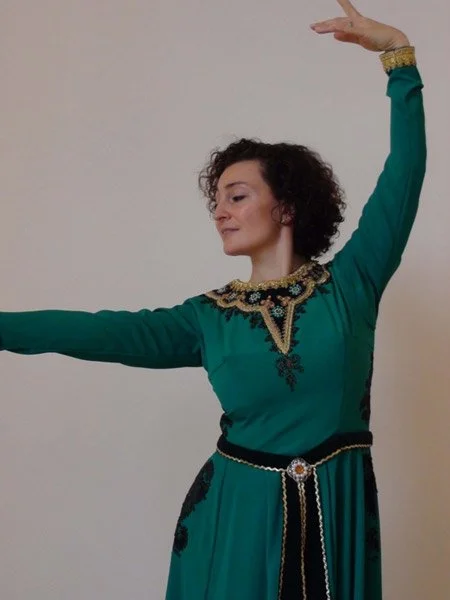
Shakeh Major Tchilingirian is an acclaimed solo dance artist, choreographer and performing artist (and a practicing orthoptist) based in London. Her unique presentation and interpretation highlight the power and spirituality of Armenian dances. Shakeh turns her dances into intricate 'narratives' of the human spirit, as in her productions Spirit and Passion, 1001 Journeys, and numerous other collaborations.
Filmmaker Atom Egoyan has described Shakeh's dance as "mesmerising... going back to the roots." Her dance is the focus of an award-winning art-documentary film Verve (2002) by Nigol Bezjian and of Doon (2025) by Russell Agro and Sarine Arslanian.
In recognition of her distinctive artistic approach, Shakeh has been invited to give dance workshops in Europe, the US and the Middle East. She regularly conducts workshops in many cities in Europe. G. MacGregor, a participant in one of her workshops, wrote: "Shakeh's devotion to the performance of Armenian dances in her dazzling costumes is as near as anything I have ever seen to an 'appearance' from ancient pictures in fairy tale children's books."
Shakeh played the role of the bride in the London premiere of Anoush opera, staged by the London Armenian Opera (LAO) in June and October 2012 and performed the lead role in "Nerdurs" at Kino Moskova in Yerevan (November 2012), a contemporary dance production about Motherland and dispersion choreographed by Teni Matian. Shakeh performed in and was the choreographer of LAO's production of Garineh operetta (2014), performed in the London premiere of Davit Bek opera (2015) and was choreographer and dancer in Sayat Nova opera (2017). Shakeh's first stage appearance was at the age of 10 in Puccini's Turandot opera at the Rudaki Hall in Tehran.
She was the Creative Artist of Jason Kouchak's Love of the Heart: Mediaeval Armenian Poetry (April 2014) and Artistic Director of AGBU London's Living Memory (June 2015). She was a performing artist in Remembering Komitas at the University of Oxford (March 2015) and in the Armenian Institute’s Salon Mashup (January 2013) at Shoreditch Town Hall, collaborating with both Teni Matian and Karen Babayan's Packing.
As part of her ongoing efforts to keep Armenian folk dance culture alive, Shakeh leads "the masses" in the tradition of circle dance at public ceremonies, feasts and celebrations, such as the specially conceived Circle of Life dance ceremonies in commemoration of human atrocities committed around the world, the Armenian Street Summer Festival in London, the Hambartsum celebrations on the Feast of Ascension, and others.
Since 2010, Shakeh has been introducing children and young people to ethnic folk dance through innovative methods and programs, such as her popular AREV Children’s Club. In recent years she has been using folk dance to stimulate and exercise with the elderly.
She is co-producer (with Laura Shannon) of Gorani, a CD and booklet of Armenian folk dance, and has authored a number of articles on the subject.
Dancing for the Voiceless
This is Shakeh’s ongoing artistic practice, rooted in dance movement and Armenian circle dance. It explores how the body carries histories that language cannot hold. At the heart of this artistic and creative path is The Circle of Life, a large-scale participatory dance gathering created during the centenary of the Armenian Genocide. The first “circle” was held at SOAS, University of London, which brought together Armenians, Turks, Kurds, Assyrians, Greeks, Iranians, and others in a shared, wordless dance ritual. Participants stood hand in hand in a single circle and moved together slowly, without choreography or spoken explanation. It was subsequently held in Istanbul, Gylling (Denmark), London, and Los Angeles. This was not a performance for an audience, but a collective act of remembrance and presence. Through shared rhythm and silence, former adversaries and strangers experienced grief, solidarity, and connection in the body.
Born in England to an Armenian-Iranian mother and English father, and raised in Iran until forced displacement during the revolution, Shakeh’s work is shaped by lived experiences of silence, rupture, and migration. Dance became the language through which unspoken histories could surface — not as trauma reenactment, but as embodied witnessing.
Dancing for the Voiceless continues to evolve — through frequent workshops and public occasions in England, Scotland, Germany, Italy, Brazil, Morrocco, and many other places. The dancing and the rituals are framed for communal healing, responding to global histories of violence, and hope. It asks how movement can hold complexity without accusation, and how collective rhythm can create temporary spaces of reconciliation.
Looking toward the future, the artist envisions continuing to give workshops and hold public events, giving voice to the voiceless through the rich Armenian folk dances and create spaces for meaning-filled dancing. She envisions long-term collaborations with communities and cultural institutions. Her work with intergenerational circles for many years, especially with the elderly, young people, and children, has been rewarding and will continue. Shakeh hopes to deepen her work as a ritual framework that can be held by others, allowing new circles to emerge, rooted in local communities while connected to a wider “Circle of Life”.
“In a fractured world, this practice insists that art is not ornamental but essential. When words fail, the body speaks. When we move together, empathy becomes physical rather than theoretical. Each circle formed becomes a quiet act of resistance — a reminder that despite devastation, we are still capable of connection, remembrance, and imagining a future shaped by shared humanity.”