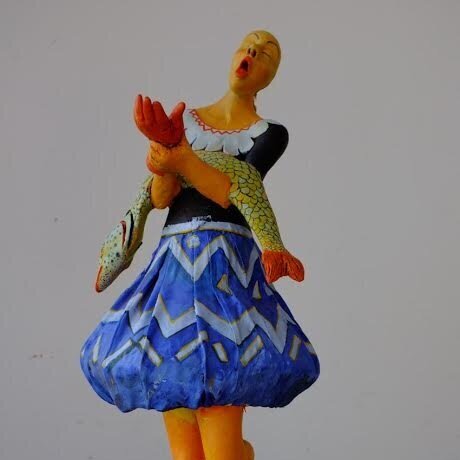
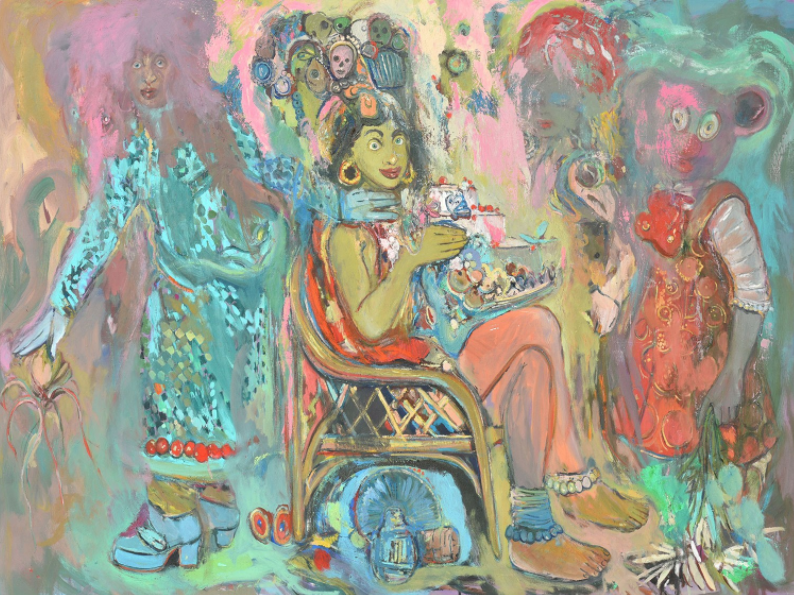
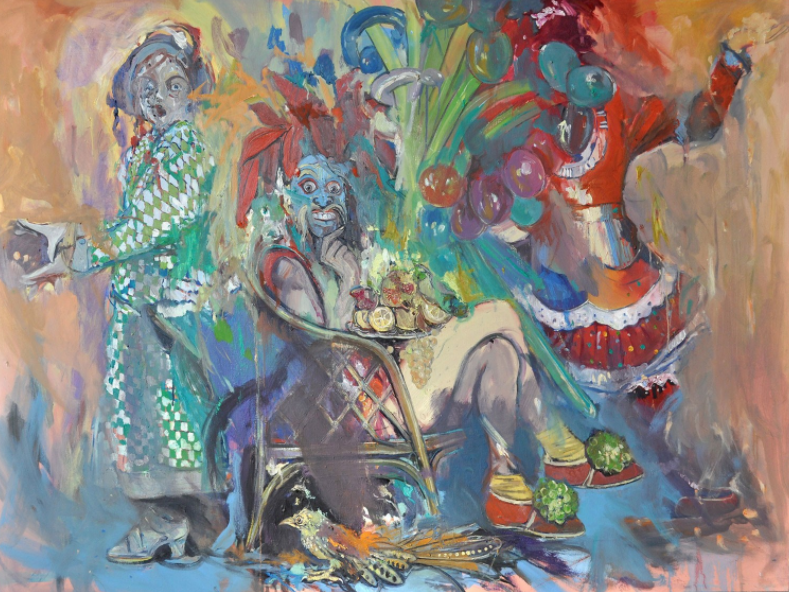
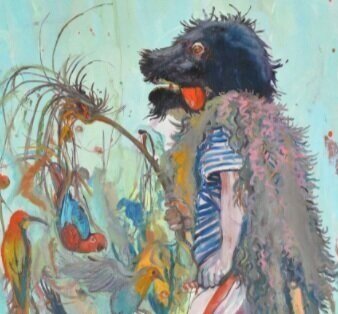
The world is topsy turvy, a woman lies under a birdcage full of chickens, an adult is being wheeled feet up in a baby carriage, a suited man prances with a rooster’s head over is face. The Bosch-like chaos of intertwining figures, animals, fruit, rolls of paper, fans, benches, trees, reminds me of the apocalyptic visions of heaven and hell. I have seen the spirit of Arshak Sarkissian in the mediaeval Armenian churches of Isfahan, Damascus and Jerusalem, in the tortures of Christ and the saints by the fresco masters. His forms and patterns pulsate with the positive-negative energy of Armenian carpets and miniatures. His rich colour palette could only be organic, never synthetic. The deep purples and apricots of Armenian mountain ranges and gorges, their inside-out, upside-down volcanic rock contortions rumble through Arshak’s visions. The humans cling together, each sealed in his bubble, yet they need one another with a desperation that is empathized by an artist still only in his thirties. Arshak’s brush is robust and his colour palette poignantly discriminating. He rapidly captures a portrait and tosses it into a composition which beguiles the eye and yet always escapes over-definition.
I have watched Arshak Sarkissian in my studio in London paint canvases and on my walls, and sculpt for hours without interruption, just as he dances, laughing and whirling, without stopping for a breath or a drink, feeding off the frenzy of his own energy. This same torrent of talent drives him on to orchestrate the visible and invisible worlds, with the death-defying resilience of his people, the Armenians, who have been close to extinction, yet dance and shout their love of life on his titanic canvases.
© Nouritza Matossian, 6 December 2019