Armenians in Manchester
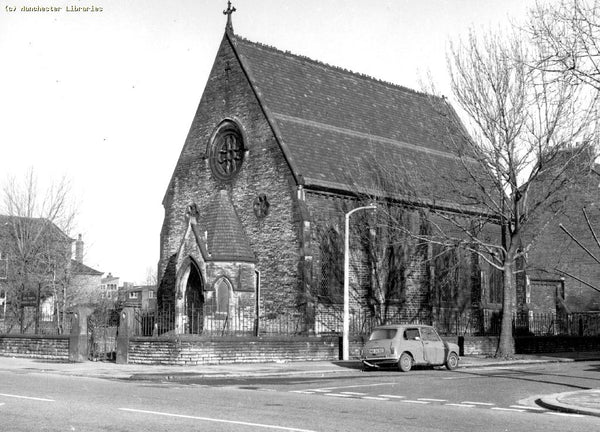
Holy Trinity Armenian Apostolic Church of Manchester, 1970 - Image source: Ani Armenian Research Center
Manchester’s Armenian presence emerged in the mid-19th century, closely tied to the city’s rise as the global centre of the cotton trade. Armenian merchants—many already active in textile commerce across the Ottoman Empire—were drawn to Manchester to establish and manage trade links with cities such as Constantinople, Smyrna, and Trebizond. By the 1840s, a small but dynamic Armenian mercantile community had formed, combining business networks that stretched across Europe, the Eastern Mediterranean, and beyond. As the community grew, Armenians established religious and social institutions, most notably the Holy Trinity Armenian Church, completed in 1870, which became the heart of communal life. While the First World War, the collapse of the Ottoman Empire, and economic decline reshaped and reduced the community, the Armenian Church in Manchester remained a vital hub throughout the 20th century, continuing to welcome new arrivals and preserving a distinct Armenian presence in the city.
Listen to excerpts from interviews, where our interviewees share about their lives in Manchester and their memories linked to Armenian food.
John Stambollouian, age 79: Origin Story
John describes his paternal grandfather Margaros Stambollouian, born in Kayseri (Cesarea), who ran the family shipping company in Istanbul before emigrating to start the Manchester branch, exporting textiles to Ottoman Empire. Mentions Manchester being the first UK Armenian community. Margaros arrived circa 1895, met and married his wife Tushko, from Smyrna, in 1904. Their first son, Jack (or Hagop, John’s father), left school to run the family business after Margaros died, in 1921. John’s maternal grandfather Leofet Yacoubian emigrated to London from Kayseri in 1912. He travelled to find a wife in Istanbul in 1914. He lived to at least 100. Mentions his parents’ marriage in 1945.
(Interviewed by Nyree, October 2024)
Ara Nahabedian, 71: About food
Remarks about his mother’s cooking, many vegetable and bulgur dishes as meat was expensive. Comments on nutrition, lent and importance of spices. Remarks on the use of arabic seven spices, which cut the smell of bad meat. Sweets and desserts. Remarks it was difficult to find lemon when first came to the United Kingdom. Remarks on making at home v. buying from the corner shop.
(Interviewed by Erica, November 2024)
Peter Shahbenderian, age 93: Father and paternal grandfather’s history
Peter’s father was raised in Merzifon, Turkiye, but was relocated to Alexandria by Peter’s grandfather after the Hamidian Massacres of the 1890s. Peter’s father then settled in Manchester, where he worked alongside Peter’s grandfather in the textiles industry while attending school in the UK.
(Interviewed by Nikolaos, July 2024)
Arda Eghiayan, age 42: Food as Identity Marker
Awareness of being Armenian through food, language, relatives and friends. Food really important. Lebanese influence on how it is prepared. When in Armenia, she was aware of some differences.
(Interviewed by Kenan, March 2025)
Ara Nahabedian, age 71: Genocide Story
Story about Ara’s father’s journey starting from Garmarik, southwest of Sivaz to Aleppo. At time of Genocide, Ara’s father 6/7 years old placed in orphanage by Ara’s grandfather Araquel due to ongoing tensions; two years later, all orphans moved to Lebanon. Remarks Ara is named after paternal grandfather. Araquel moved to Aleppo, Syria, reunited with son. Description of life in Aleppo; family working in foundry. Story about Ara’s mother’s family journey from Nigde, Cilicia. Remarks Ara’s grandmother, Siroun, pregnant and forced on march from Cilicia to Syrian desert. Ara’s mother born on march named after Queen Victoria of Britain. Remarks Siroun died on the march. Story of maternal grandfather marrying sister-in-law, both had survived march from Nigde to Aleppo. Ara’s mother and father had arranged marriage in Aleppo. Ara is their fifth child.
(Interviewed by Arda, June 2025)
Maral Ovanessoff, age 52: Food
Discussion of the food loved by all. Difficult to identify specifically Armenian cuisine. Describes what lahmacun is and its Armenian specificity.
(Interviewed by Gabriella, July 2024)
Nyeiri Gharib, age 25: Parents’ Story
Story of her father’s birth in Tehran, Iran and his Iranian-Armenian heritage; story of her father’s school and university education in the UK; story of the impact of the 1979 Iranian revolution on her father and his family; story of her father’s subsequent return to Iran; story of her parents meeting in Tehran and their subsequent move in 1996 to Manchester, UK and Nyeiri’s birth. Aspects of Nyeiri’s mother’s Iranian-Armenian heritage; story of the difficulties for her mother in moving to the UK; mention of her parents’ speaking Armenian at home and Armenian, Iranian and some English at school in Iran; mention of Armenian and English being spoken in Nyeiri’s childhood home. Story of her parents’ move to Manchester.
(Interviewed by Erica, December 2024)
Richard Anooshian, age 73: Food memories
Richard mentions names of dishes made for large family meals, what the table looked like. Mentions the hybrid nature of their American Thanksgiving meal: American and Armenian dishes cohabiting. Church picnics. Richard misses manti especially. Time-consuming process of making Armenian dishes.
(Interviewed by Max and Melanie, June 2024)
Lilit Mehrabyan, age 44: Meeting Husband
Arrival in the UK, details of extended family in the USA. Relates details about meeting husband on a dating website for Armenians and the importance of that.
(Interviewed by Erica, January 2025)
Tina Afiyan Breiova, age 33: Armenian food culture
Every summer in Armenia, Tina describes it as an ‘open air restaurant.’ Homemade food brought every day by family members. Detailed descriptions of favourite dishes.
(Interviewed by Arda and Nikolaos, June 2024)
Peter Shahbenderian, age 93: Childhood in Manchester: Textile Business, Blitz
Peter was raised in Manchester. Mentions the influence of mid-19th century Armenians over the textile industry. He was born in Withington (a suburb of Manchester, England). He survived the Blitz before being evacuated to Derbyshire. Attended Buxton College there for 10 years.
(Interviewed by Nikolaos, July 2024)
Vazken Davidian, age 59: Armenian Coffee
Coffee sourced from Henry’s Coffee, owned by third-generation Romanian-Armenian, which he came across in Armenian Museum of America in Boston. Childhood memory of drinking coffee with grandmother; she would share sips during visits.
(Interviewed by Max and Melanie, September 2024)
John Stambollouian, age 79: Letter from December 1916
John reads out letter dated 1916 from his father Hagop to his own father, Margaros.
(Interviewed by Nyree, October 2024)
Ara Nahabedian, age 71: Doctor in England
Story of how Ara was asked, while pursuing university education in Beirut, Lebanon, if wanted to go to Oswestry, England to continue medical training; Ara accepted as wanted to learn about non-war trauma. Comments on difficulties of citizenship and getting a passport. Story about how he managed to get a passport for one year and went to UK for two-year training from 1984. Comments on how was able to stay working at Crewe Hospital and got a British passport. Remarks he never returned to Syria.
(Interviewed by Erica, November 2024)
Nyeiri Gharib, age 25: Sense of Armenian Identity
Aspects of her sense of Armenian identity: story of the impact of not having Armenian peers whilst growing up in Manchester; mention of not identifying with or seeing herself in the Armenian community; story of her experience of the Armenian school in Manchester; story of the significance of going through the Birthright programme including an internship in Armenia; story of how exposure to a wider group of Armenian peers enabled her to reconcile different parts of her identity.
(Interviewed by Erica, December 2024)
Lilit Mehrabyan, age 44: Sheffield, Aberystwyth, Liverpool, Manchester.
Lilit gives details about husband’s university career in the UK (he moved to the UK to do his PhD in Physics at Sheffield University). Discusses their moves from Sheffield, to Aberystwyth (Wales), Liverpool and then Manchester. Recounts feeling isolated in Sheffield and Wales, then slowly finding job opportunities for herself. Talks of the importance of the Armenian Church in Manchester and finding community there.
(Interviewed by Erica, January 2025)
Peter Shahbenderian, age 93: Armenian Community in Childhood and Antisemitism
Mixed with different communities, Peter was a target of antisemitism, which was prevalent in Manchester at the time.
(Interviewed by Nikolaos, July 2024)
John Stambollouian, age 79: Cotton Mills Memories
Describes his father and uncle working in the Lancashire cotton industry; anecdote about visiting mills with uncle and seeing the young women mill workers who were deaf from the noise of the Lancashire looms. Reads out a cutting about his uncle’s last cotton deal at the Manchester Royal Exchange.
(Interviewed by Nyree, October 2024 )
Lilit Mehrabyan, age 44: Armenian Community in Manchester and Upkeeping Traditions
Relates experience of the Armenian community in Manchester, the importance of the church there, and knowing women of the same age with children. Describes how this and the organised events reduces her concern about forgetting culture. Talks about Armenian traditions such as boiling eggs for Easter, using coriander leaves and red onion skin to decorate the shells, and the resulting egg fights. Christmas being celebrated on the 6th of January as well as 25th December, and the water festival.
(Interviewed by Erica, January 2025)
Peter Shahbenderian, age 93: Archbishop Leon Tourian and Church in Manchester
Anecdote about the assassination of Archbishop Leon Tourian. Mentions a small, close-knit Armenian community during his childhood which was centralised in the Armenian Church in Manchester. Taken to church every week from the age of 6.
(Interviewed by Nikolaos, July 2024)
John Stambollouian, age 79: Questioning about meaning of Armenian Identity
Discussion about the church and language. John comments on his parents not speaking Armenian and his regret at not speaking Armenian; remarks on difficulty of feeling connected to Armenian heritage without speaking the language. Mentions his mother being more conscious of Armenian heritage than his father. Mentions recognition of heritage through surname. Describes uncertainty yet pride, gratitude about Armenian identity; the meaning of being third-generation Armenian. Mentions Elif Shafak.
(Interviewed by Nyree, October 2024)
Ara Nahabedian, age 71: Armenian Life in Aleppo
Description of Armenian life in Aleppo. Comments on movements, housing, schools, churches and shopping. Remarks each street had a bakery as no oven at home. Comments summer holidays were three months, so boys sent to work with family members/apprenticeship. Girls learnt about making home.
(Interviewed by Erica, November 2024)
Peter Shahbenderian, age 93: Visiting Armenia
Invited to Armenia for a month by the British ambassador in Armenia at the time. Recalls being met in Armenia with a paradoxical feeling of belonging in a place you have never been. Physiognomic similarities and Armenian language created an emotional impact. Acknowledges the divide between him and the local Armenian people. Recognises the cultural differences among Armenians brought on by the diaspora which can be helped through meeting each other.
(Interviewed by Nikolaos, July 2024)
Ara Nahabedian, age 71: Languages
Description of use of languages within his family. Comments would speak Turkish with one uncle, but otherwise spoke Armenian; little opportunity to speak Arabic but can read and write. Remarks English and French important in educational settings. Knows many Turkish proverbs.
(Interviewed by Erica, November 2024)
Peter Shahbenderian, age 93: Parent’s silence about the Genocide
Peter’s parents were not forthcoming about their childhoods. Genocide-related trauma led them to brush over their own childhoods and encourage their own children to assimilate in their new home.
(Interviewed by Nikolaos, July 2024)
Ara Nahabedian, age 71: The Armenian Church in Manchester
Description of his discovery of the Armenian Church in Manchester and its history linked to Armenian merchants from the Ottoman Empire. Remarks on the cost of Armenian Church in Manchester; interior Armenian-style, exterior Anglican church. Description of the other Armenian Churches in London. Mentions authors Joan George, Peter Balakian. Description of importance of Armenian Church in Manchester to him and the different branches of Armenian Christianity. Story of how he and his wife made a written account of the Armenian Apostolic service available.
(Interviewed by Erica, November 2024)
Peter Shahbenderian, age 93: Discovering Parents’ History
Peter led a tour for American-Armenians tracing their ancestors through Turkey. He recalls being very moved by a visit to his father’s town of origin. Peter’s mother had a happy childhood in Chalcedon (now Kadıköy). He notes Armenians do not celebrate their birthdays, but their name days. Peter was gracefully facilitated by a bishop and a mayor in tracing his parents’ history.
(Interviewed by Nikolaos, July 2024)
The Armenian Institute is proud to be conducting the project Heritage of Displacement: Oral Histories from the UK Armenian Communities (2023–2026), funded by a National Lottery Heritage Fund grant, thanks to National Lottery players, to document and preserve stories of Armenian diaspora heritage in the UK.
With this large-scale special project, the Institute aims to help British-Armenian communities take part in preserving their heritage of displacement, migration, and resettlement. This oral history project collects the memories of members of the Armenian diaspora settled in London and Manchester, the two largest Armenian communities in the UK. Family stories and personal relationships with cultural traditions are being recorded and preserved, with a desire to shed light on paths of migration, and how Armenians have recreated ‘home’. This new digital archive of recorded interviews, material heritage, and photographs are to be hosted on a new dedicated website that will remain available as a resource for the community and for academic research.
Throughout the process, the Armenian Institute has further promoted community engagement, through the organisation of workshops, trainings, digital outputs, and finally exhibitions showcasing the archive that this project has created.
The Armenian Institute has notably participated in the British Library’s display: Britanahay Բրիտանահայ: Armenian and British, open to the public at the Library's premises on Euston Road, London, in its Treasures Gallery, from 27 September 2025 until 22 February 2026.
This remarkable showcase brings together printed works and manuscripts from the Library’s collection, illuminating centuries of British-Armenian connections. Enriched with gripping audio clips from the Armenian Institute’s Heritage of Displacement oral history project, the display offers a vivid encounter with voices, histories, and traditions that continue to shape our shared heritage.